
AI-Powered Document Automation for Specialty Pharma
How Katyella delivered a production-ready AI platform in 4 weeks with almost zero meetings
4 weeks
SOW to delivery
75%
time reduction
100%
claim coverage
<$500
monthly infra cost
Client
Evo Advertising (via Lucien Vaccaro)
Industry
Specialty Pharma / Healthcare Market Access
Engagement
Fixed-scope MVP with optional retainer
The Challenge
Evo Advertising's pharma client faced a critical bottleneck in their market access workflow: Letters of Medical Necessity (LMNs).
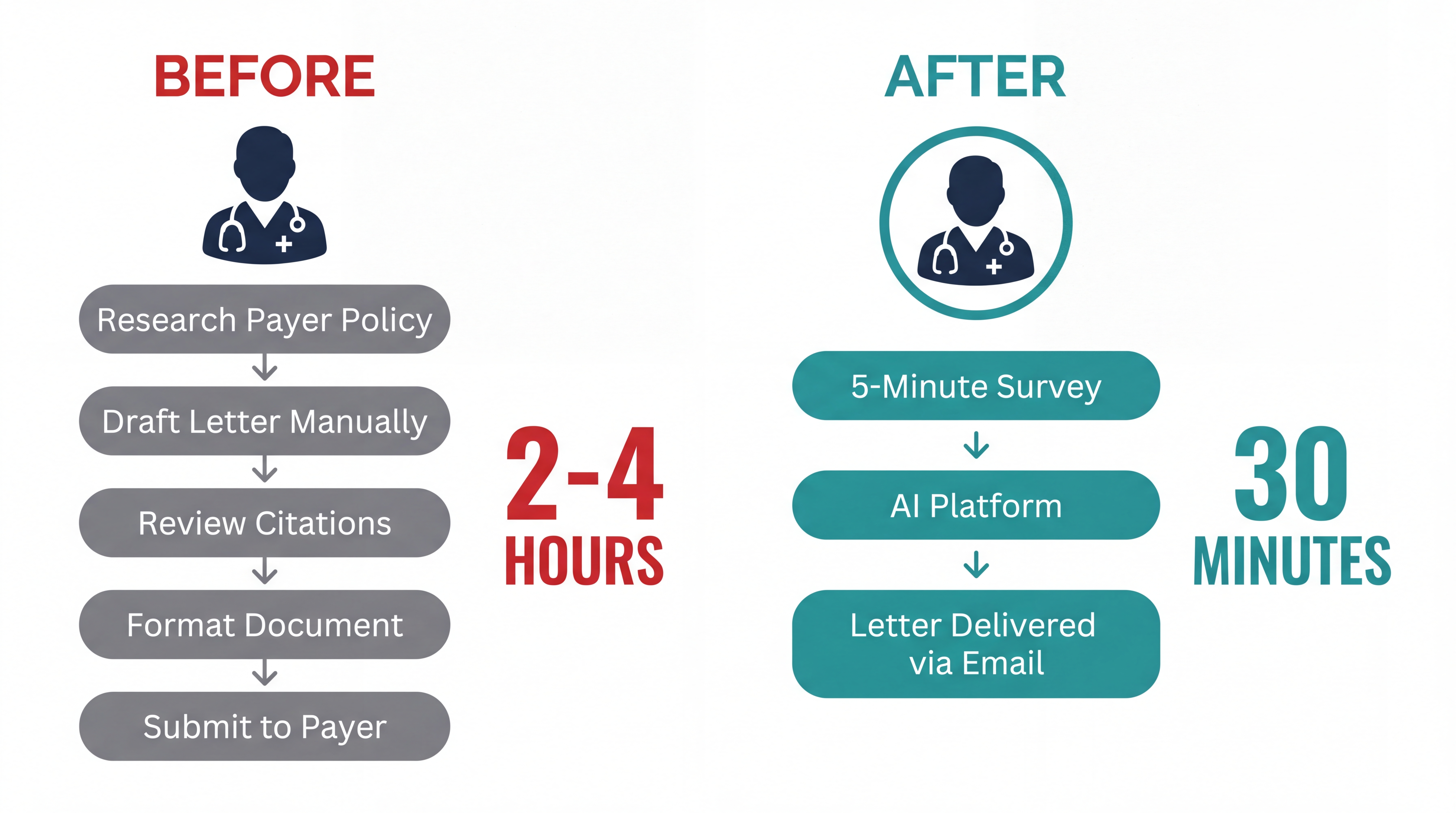
Every time a physician needed to prescribe a specialty gene therapy, they had to manually draft a multi-page letter to the patient's insurance payer, citing specific clinical evidence, aligning to payer-specific coverage criteria, and formatting everything to regulatory standards.
Hours per letter
Each LMN required 2-4 hours of physician time to research payer policies, pull clinical citations, and draft custom prose.
Payer fragmentation
Every payer has different coverage criteria, required documentation, and policy language. One template doesn't fit all.
Compliance risk
Manually assembled letters risked omitting required clinical claims or using non-approved language.
Provider friction
The administrative burden discouraged providers from prescribing, directly impacting patient access to treatment.
The Solution
Katyella built a full-stack AI platform that transforms a 5-minute physician survey into a complete, payer-compliant Letter of Medical Necessity, generated in under 30 minutes.
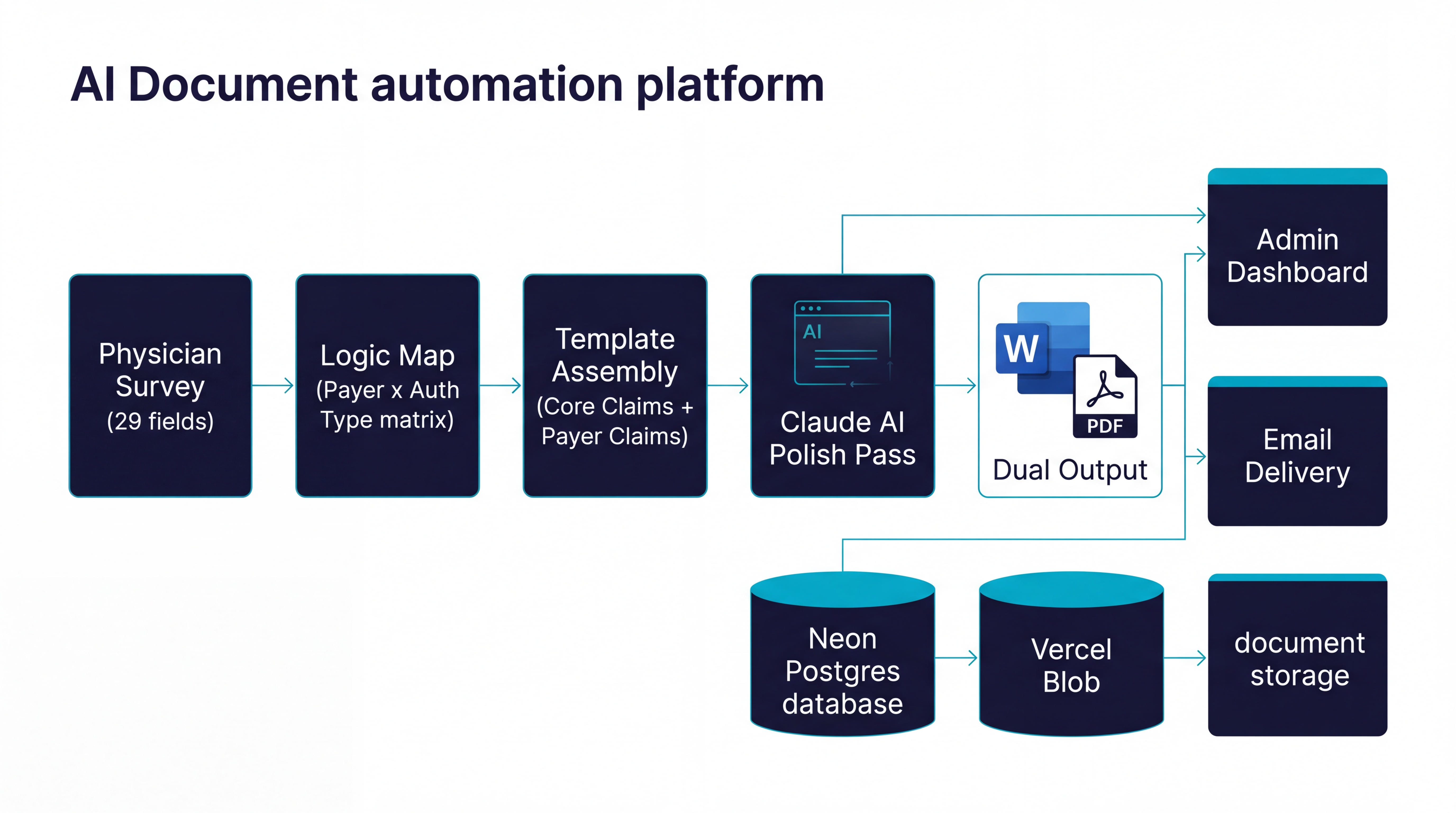
Guided Survey
A structured form captures 29 clinical data points across 6 sections: coverage details, clinical profile, functional assessments, treatment history, quality-of-life impact, and clinical rationale.
Deterministic Template Assembly
Survey answers are routed through a logic map that selects the correct pre-approved clinical claims for the specific payer and authorization type. Every claim is deterministically selected from a curated library.
AI Polish Pass
Claude processes the assembled draft, improving grammar, flow, and professional tone without removing or altering any clinical claims. If the AI pass fails, the system falls back to the deterministic draft.
Dual-Format Output
The platform generates both an editable Word document for physician review and an archival PDF simultaneously. PHI placeholders appear in highlighted brackets for easy identification.
Email Delivery + Admin Dashboard
The completed letter is delivered to the physician's inbox within 60 seconds. A searchable admin dashboard tracks every submission with a complete audit trail.
System Architecture
Payer Intelligence
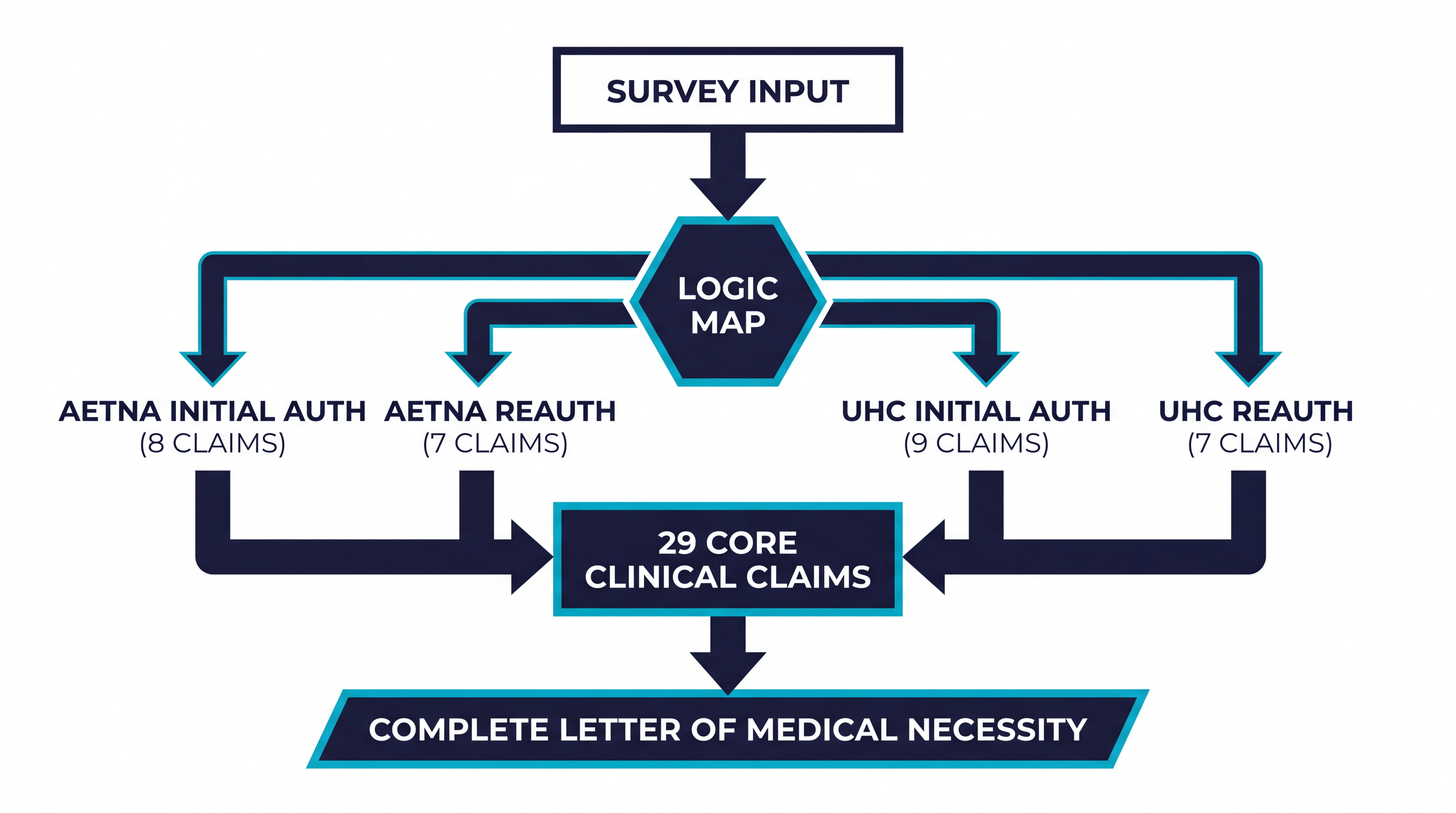
The platform supports a matrix of payer-specific claim libraries, ensuring every letter meets the exact requirements of the target payer.
| Initial Authorization | Reauthorization | |
|---|---|---|
| Aetna | 8 payer-specific claims | 7 payer-specific claims |
| UnitedHealth | 9 payer-specific claims | 7 payer-specific claims |
Plus 29 core clinical claims shared across all payers, each derived from approved clinical evidence with citations.
Tech Stack
Frontend
Next.js 16, React 19, TypeScript, Tailwind CSS 4
AI Engine
Claude API (Haiku 4.5) via Anthropic SDK
Database
Neon Serverless PostgreSQL + Drizzle ORM
Infrastructure
Vercel, Vercel Blob, Resend
The Delivery
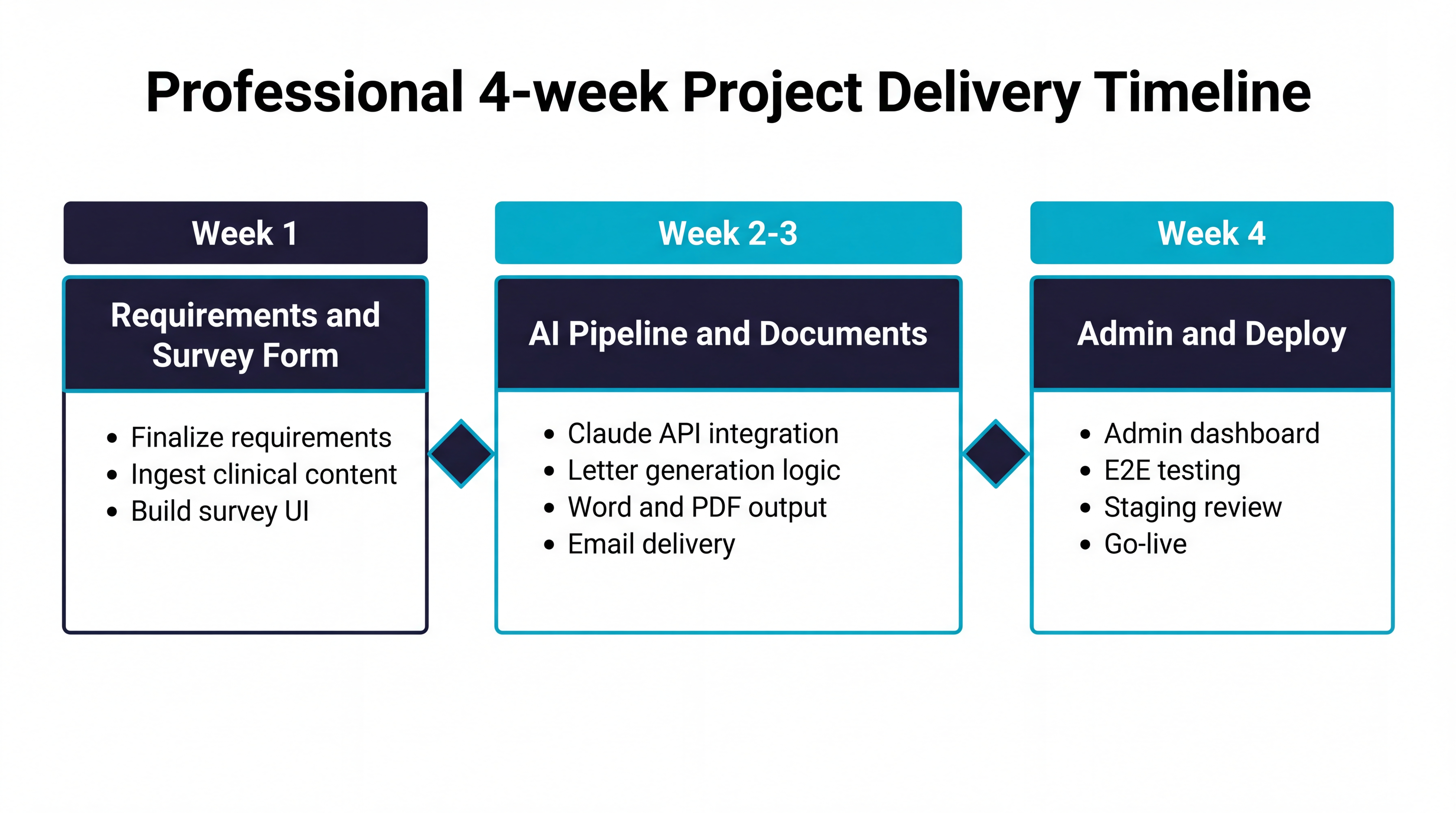
4 Weeks. Minimal Meetings.
What the client expected
Weeks of discovery meetings, multiple design revisions, iterative feedback loops to nail the look and feel.
What actually happened
Katyella shipped full working prototypes early and often, paired with async video walkthroughs. The client could test real functionality, not review mockups.
Style and UX questions resolved themselves because the client could use the thing instead of imagining it.
Results
Speed
Quality
- 100% of required clinical claims included in every letter
- Payer-specific policy alignment baked into the logic
- Complete audit trail for every submission
Delivery Efficiency
- 4-week delivery from signed SOW to working platform
- Working prototypes replaced meetings
- Async video walkthroughs instead of status calls
Business Impact
- Demo platform led to an expanded engagement
- Proved viability of AI-assisted document automation
- Reusable architecture for additional products and payers
Why It Worked
Prototypes Over Presentations
Instead of burning weeks on wireframes and design reviews, Katyella shipped functional prototypes within days. The client tested real software, not slide decks. This collapsed the feedback loop from weeks to hours.
Deterministic AI, Not Prompt Roulette
The letter generation pipeline doesn't rely on AI to "figure out" what to include. A logic map deterministically selects every required claim. AI only handles prose quality. If the AI layer fails, the letter still generates correctly from the template.
Full-Stack, One Team
No handoffs between a design agency, a frontend shop, and a backend contractor. Katyella owned the entire stack: survey UX, AI pipeline, document generation, email delivery, and admin dashboard. One team, one codebase, one deployment.
Right-Sized Architecture
Serverless Postgres, edge-deployed Next.js, blob storage, transactional email. No over-engineered microservices. No Kubernetes. Infrastructure costs under $500/month, not $5,000. The architecture matches the actual scale of the problem.
Ready to Automate a Manual Workflow?
We build production systems with AI, not proofs of concept that need to be rebuilt.